What “Lacking Energy for Production” Really Means
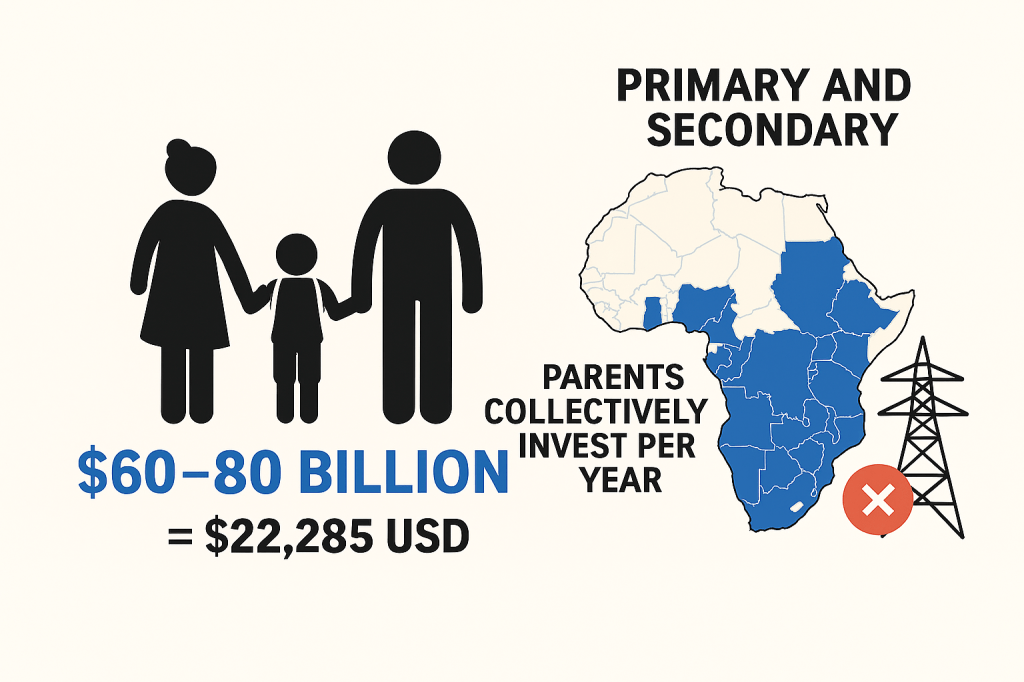
Parents in Sub-Saharan Africa collectively invest an estimated $60–80 billion USD per year in their children’s education — covering fees, uniforms, transport, meals, medical bills and digital access across primary and secondary levels.
Breaking Down the Collective Investment
📘 Number of Students
- Over 300 million children are enrolled in primary and secondary school across Sub-Saharan Africa
- Roughly 50% of education costs are covered by households — especially in low-income and rural areas
📊 Average Annual Household Spending
- Primary school: ~$200–$400 USD/year per child
- Secondary school: ~$600–$1,800 USD/year per child
- Urban families often pay more — especially for boarding, private schools, or digital access
- Supplemental tutoring or exam prep.
🧮 Total Annual Investment
- Estimated $60–80 billion USD/year across the region.
- This includes
- Tuition and fees
- Uniforms and books
- Transport and meals
- Digital access (phones, data, power banks)
- Supplemental tutoring or exam prep
What’s at Stake!!!
When energy poverty blocks graduates from using their skills — no power for tools, machines, or digital work — it’s not just a missed job.
It’s tens of billions in family sacrifice wasted in the dark.
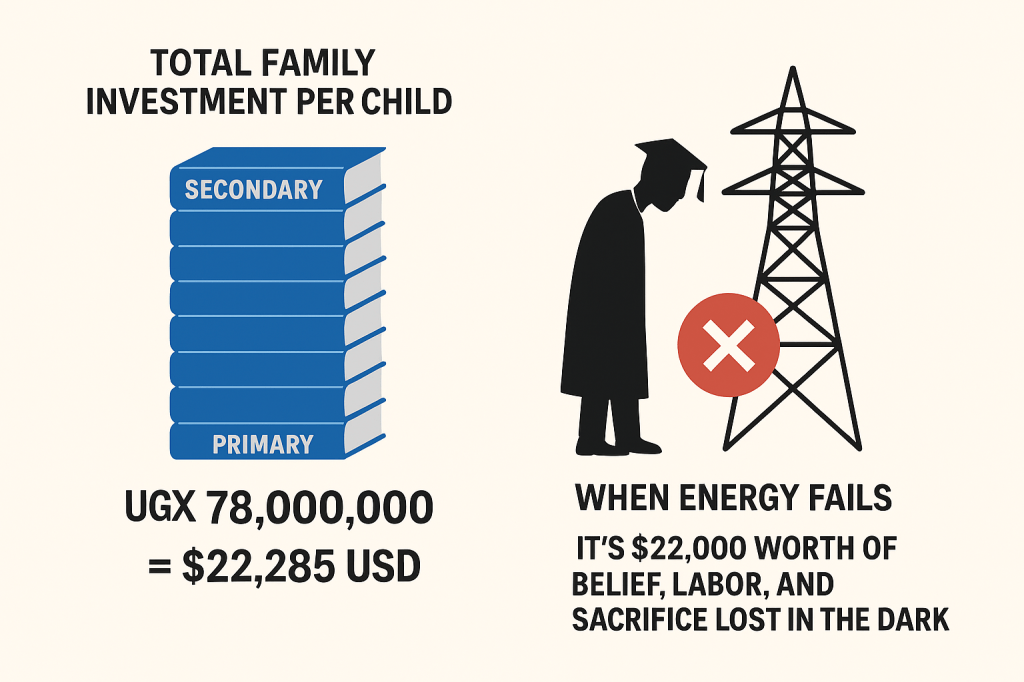
- $22,000 USD per child over 13 years (at 6 million UGX/year)
- Millions of families betting everything on education — only to hit a wall when energy fails.
⚡ Energy as a Driver of Local Economies
In European cities, energy is invisible — but it’s everywhere. It doesn’t just light homes. It runs the city’s rhythm.
🕔 5:00 AM
Electric buses roll out of depots. Drivers begin their shifts in silence — no fumes, no noise, just clean motion.
Ferries warm up too, gliding across the archipelago, carrying commuters, goods, and schoolchildren between islands.
🕖 7:00 AM
Bakeries fire up induction ovens. A single plug powers a morning’s worth of sourdough and cinnamon buns.
Meanwhile, freight ships dock at Stockholm’s ports — unloading containers of electronics, textiles, and food. Many now run on shore power, cutting emissions while at berth.
🕘 9:00 AM
Freelancers log on from energy-efficient homes. Laptops, routers, and coffee machines hum quietly.
At the same time, high-speed trains depart from Stockholm Central — bound for Copenhagen, Oslo, Hamburg. Powered by clean electricity, they carry workers, students, and goods across borders.
🕛 12:00 PM
A vertical farm harvests greens under LED lights. Solar panels offset the load.
In Gothenburg, electric ferries shuttle passengers across the river — part of Sweden’s push for zero-emission public transport.
🕒 3:00 PM
A metalworker in a suburban garage fabricates custom bike parts with a CNC machine.
In Malmö, trains from Berlin and Hamburg arrive — linking Nordic cities to the heart of Europe’s economy.
🕕 6:00 PM
Families cook on induction stoves, wash clothes, and help kids with homework — all powered by a grid that’s 98% fossil-free.
Meanwhile, cargo ships leave port, carrying Swedish timber, steel, and machinery to global markets — increasingly powered by hybrid engines and biofuels.
🕘 9:00 PM
A startup team uploads a prototype to a 3D printer. It runs overnight.
On the tracks, night trains depart for Hamburg, Berlin, and Vienna — offering low-carbon travel and mobile workspaces.
For Years, Parents Have Paid — But the Grid Hasn’t Delivered
Every year across Sub-Saharan Africa:
- Over 30 million children graduate from secondary or vocational school
- Their parents have paid 6 million UGX per year, for 13 years — totalling $22,000 USD per child
- That’s $660 billion USD in family investment — every single year
- Up to 1.26 million graduate-level jobs are lost annually
- That means millions of parents are educating their children…
to no job, no power, no future
For Every time a child graduates into darkness,
we erase 13 years of sacrifice: fees paid, meals skipped, debts taken, hope held.
⚡ The Urgency
If we don’t power the bridge between education and employment,
we’re asking parents to climb for 13 years — and then stopping them at the summit.
Energy isn’t just infrastructure. It’s justice.
It’s the promise that learning leads to doing.
That belief leads to livelihood.
That no parent’s sacrifice ends in silence.
This isn’t just a policy failure.
It’s a betrayal of belief — repeated 30 million times a year.
 Vaultfluence
Leave a comment